After I return to the city it takes some time to get used to streets and houses again as if I had been with the plants for a long time. The sky is still grey, but I walk around the old town some more and find the many minority houses of worship: An Armenian church, a synagogue and a mosque. Batumi is the capital of the Autonomous Republic of Adjara - the conflict is settled for this region - and the Adjarians used to be Muslims. Today 30% of the region's population are Sunni Muslims while more than 60% are Georgian Orthodox.
I also very much enjoy the less crazy, but probably more lasting architecture of two-story wooden town houses with carved and doors with forged decorations, flowers and wine growing in the most unlikely places around them. I get to join many people just going out to the beach for the sole purpose of watching the sun set over the Black Sea. Such a peaceful atmosphere on a beach far from empty.Balkans to Baku - I am fortunate to go on another long journey, many countries I wanted to see for so many years, now the time has come! Welcome, dobrodošli, mirë se vjen, hoş geldiniz, კეთილი იყოს თქვენი მობრძანება, qædæmin mübaræk olsun! I hope you'll enjoy my impressions and I'll be happy to read your comments!
Samstag, 9. August 2014
Botanical Garden - Latvians are Everywhere!
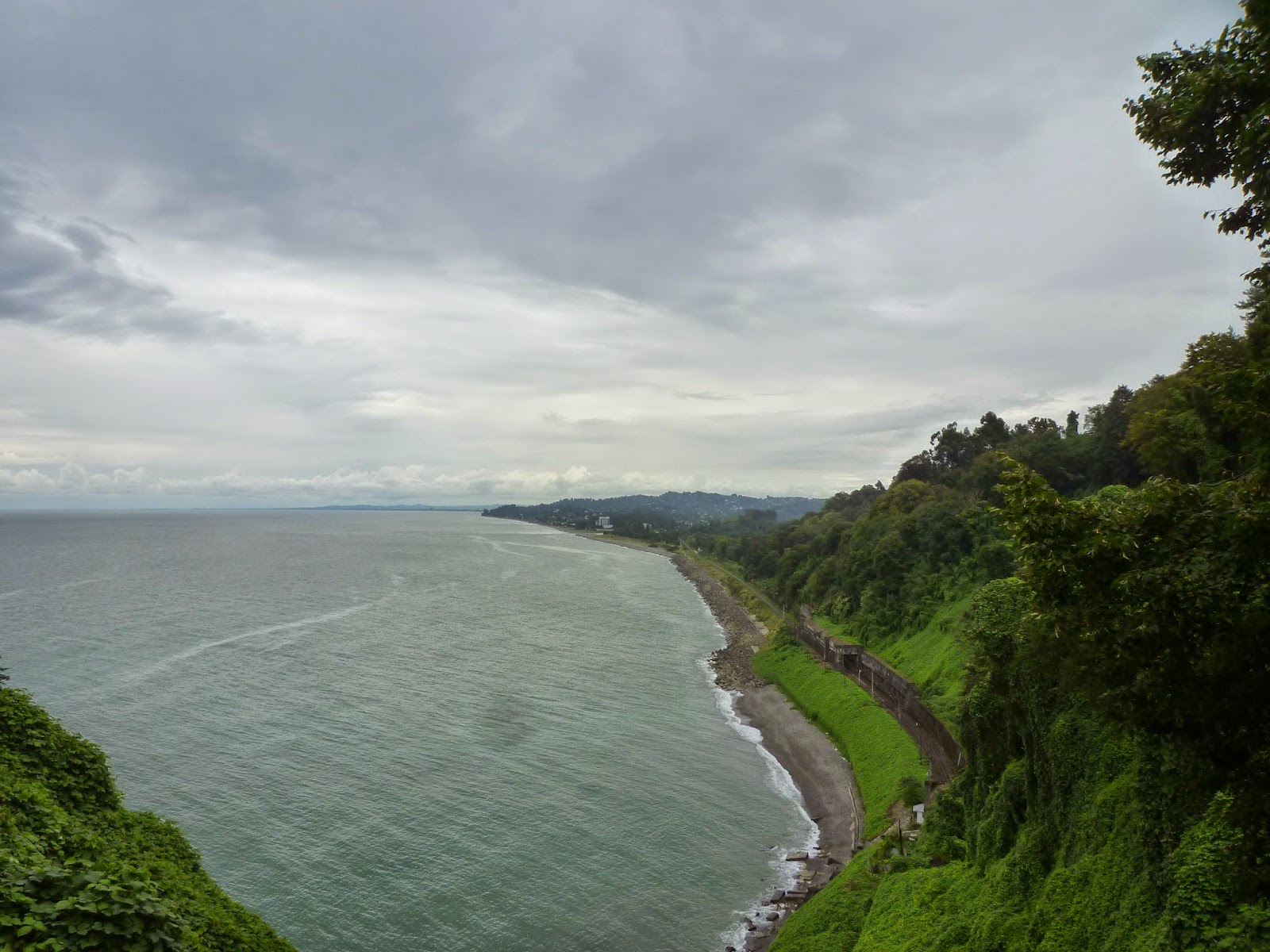
One of the things one should not miss when visiting Batumi is the Botanical Garden. While I happen to be here on the first rainy day in weeks I stick to my plan and find the minibus to go North to the gates of the garden. It was established in 1912 at the steep shore and with the slope towards the sea and the valleys and hills to the inland side it is possible to imitate different climate zones on this small area - though for a garden it is quite big. As I gather from the bilingual Georgian/English maps there are citrus groves, a bamboo forest, a rose garden, a bonsai garden and, of course, gardens dedicated to plants from specific regions of the world. It even holds a small railway station, I'm not sure if it still is active, but the coastal train does go along here and through the tunnel integrated in the garden. Early on my walk through the garden I hear two couples discussing over a tree and its trilingual (Georgian/Russian/Latin) sign what kind of fruit this actually is. They speak Latvian! I tentatively join the conversation and happily surprised they welcome me to join them for the walk. It is really great to explore this garden together, talk about Georgia, Latvia, and Germany and especially doing so in Latvian totally unexpectedly. Latvians really are everywhere. I would have enjoyed the garden on my own, too, and probably not less, but in a different way. Walking in a group of five we share the joy to be in this vast and diverse greenness and point out to each other different especially amazing trees and fruit and flowers. The Latvians get picked up by their Georgian friend at the back gate and I return - on a different path, of course - to the front gate, this time being swallowed by all the huge leaves and woods.
Very Warm Welcome To Why-Not-Country: Batumi
Once more I feel so lucky to have found a fantastic host, we connect instantly and always have something to talk about, be it Georgia or our home countries or other countries or living in a foreign place and how places turn not so foreign, about finding the right place, both geographically and metaphorically.
She works during the day I set off to explore the city by myself on the first day and I find it both very accessible and great fun to walk around as it looks to me like a happily unrestrained expression of freedom and a bit of craziness. That is not the whole story, of course, but the huge colorful and blinky buildings and sculptures are surely what surprises me most after having noticed the raging building mania along the seaside - and the neatly renovated boulevard between the sprouting blocks and the pebble beach.
One of the most astonishing buildings is the not yet functioning technical university that holds a small Ferris wheel near its peak.Some features of new sights and buildings are even more impressive with all their colorful lights. In the warm and early darkness I get to see a lot of it as Christy and I both like walking while talking and enjoy strolls around the illuminated city.
I really like the Alphabet Tower, as weird as it may seem, but when you think about it, what a beautiful thing to have a language an script you cherish so much that you build a cheerfully illuminated tower close to a much frequented beach to celebrate it! I managed to learn most of the Georgian alphabet and really enjoy being able to more or less decipher what the small curly letters mean. I also love how quotations are inscribed on one of the promenades and how another colorfully illuminated sight also illustrates a work of literature, one dealing with a bi-cultural relationship at that. Not far from the Alphabet Tower there is the moving double statue of Ali and Nino, the main characters of a novel of the same title. Set in Baku in the wake of the 20th century it describes the love of Georgian Christian princess Nino and Azeri Muslim nobleman Ali from his perspective. I will write some more about it when I am in Baku. The statues of a man and a woman move toward each other, drift through each other and part again while changing colors. I guess everyone can take their own metaphors from that...
I had contacted another couchsurfing host before Christy. Ruslan couldn't host me, but he is happy to meet for a meal and show me around his hometown. He has his own law firm and is active with some different youth groups and so he can give me detailed insights on many topics of Georgian history, politics and the recent changes taking place in the country.
We are joined by Christy for another very Georgian dish: Khachapuri (a kind of yeast pie filled with Georgian cheese) and Georgian lemonade. Cheerful company of three untypical people, as we find out: A Georgian who doesn't wear black, an American who speaks foreign languages and a German who doesn't drink beer.
When we talk a little about the countries I already visited on this trip I mention the Bruce Lee statue in Mostar and how at least one of the explanations how it got there was someone suggesting it and people answering 'well, why not?'. Ruslan really likes this approach. Georgia, he says, is a why-not-country, too. This phrase holds some potential to characterize countries, I think and add Germany is more of an I-can-tell-you-exactly-why-not-country. Maybe some things just take a bit longer that way... One of the things I love so much about travelling is how it refines my perception in ways that also make me see other parts of the world, including my home in a different light or in more detail.
The newer part of the Boulevard...
...and beyond
The old Boulevard...
Art between land and sea
One of the most astonishing buildings is the not yet functioning technical university that holds a small Ferris wheel near its peak.Some features of new sights and buildings are even more impressive with all their colorful lights. In the warm and early darkness I get to see a lot of it as Christy and I both like walking while talking and enjoy strolls around the illuminated city.
Technical university building and statue of Medea holding the Golden Fleece
I really like the Alphabet Tower, as weird as it may seem, but when you think about it, what a beautiful thing to have a language an script you cherish so much that you build a cheerfully illuminated tower close to a much frequented beach to celebrate it! I managed to learn most of the Georgian alphabet and really enjoy being able to more or less decipher what the small curly letters mean. I also love how quotations are inscribed on one of the promenades and how another colorfully illuminated sight also illustrates a work of literature, one dealing with a bi-cultural relationship at that. Not far from the Alphabet Tower there is the moving double statue of Ali and Nino, the main characters of a novel of the same title. Set in Baku in the wake of the 20th century it describes the love of Georgian Christian princess Nino and Azeri Muslim nobleman Ali from his perspective. I will write some more about it when I am in Baku. The statues of a man and a woman move toward each other, drift through each other and part again while changing colors. I guess everyone can take their own metaphors from that...
More light and art in Batumi at night. Rainbow colored to the right: The Adjarian ministry of justice
I had contacted another couchsurfing host before Christy. Ruslan couldn't host me, but he is happy to meet for a meal and show me around his hometown. He has his own law firm and is active with some different youth groups and so he can give me detailed insights on many topics of Georgian history, politics and the recent changes taking place in the country.
We are joined by Christy for another very Georgian dish: Khachapuri (a kind of yeast pie filled with Georgian cheese) and Georgian lemonade. Cheerful company of three untypical people, as we find out: A Georgian who doesn't wear black, an American who speaks foreign languages and a German who doesn't drink beer.
When we talk a little about the countries I already visited on this trip I mention the Bruce Lee statue in Mostar and how at least one of the explanations how it got there was someone suggesting it and people answering 'well, why not?'. Ruslan really likes this approach. Georgia, he says, is a why-not-country, too. This phrase holds some potential to characterize countries, I think and add Germany is more of an I-can-tell-you-exactly-why-not-country. Maybe some things just take a bit longer that way... One of the things I love so much about travelling is how it refines my perception in ways that also make me see other parts of the world, including my home in a different light or in more detail.
Freitag, 8. August 2014
Getting to Georgia
Getting from Erzurum to Batumi poses some unexpected challenges to me. First of all the bus ride is the most breakneck trip I've ever been on and the only time on this trip when I was actually worried if we'd make it to our destination as the senior driver sped down the steep and narrow sandy road along the steep cliffs, mostly above a river/dammed lake. Spectacular landscape anyway, and I even took some pictures!
I also need to change the bus once more at this company's headquarters in Artvin. It's not a problem, but it still makes me a bit nervous when suddenly everyone leaves the bus and I need to figure out with no one speaking English or German that it's just what everyone has to do in order to continue the trip as this is the regional bus hub. After a while there is another change in the landscape. Sand and rocks that show impressive traces of how they were folded up in colorful layers by the tectonics that formed this region give way to very green and round, yet still steep hills. Tea plantations! As I am an addicted consumer of black/green tea this looks like heaven to me! (No photos once more, though, the camera ran out of battery and the charged one is in the trunk...)
The final destination of the bus is Hopa, some ten kilometers from the Georgian border. Apparently there is no bus leaving to Batumi or even the border town of Sarp (Turkish)/Sarpi (Georgian) anymore today (I suspect there is, but my Turkish is not sufficient to figure that out, the taxi driver, however, is keen on driving me, of course). With all the ATMs broken down I guess I get ripped off a little, but Euros are welcome to pay for the short ride along the shore line.
Sarpi border crossing point is quite busy and I really have no idea where I have to go and if I need to do some paper work first or not, from the information I read before I think I don't, but can I just pass by this official looking window...? I try hard to switch my brain to Russian and do manage to confirm my information: As a German I just walk in and get in line for the border control.
So I join a huge crowd of Georgians heading home from shopping in Sarp(i) markets. I feel just a bit weird in my violet and blue clothes and my bright green backpack among all these men (and, mostly, women) in black. There are some problems with the laptop, but finally the young guy at the desk makes it work again, asks me to step back to take a photo, and then I get my entry (by car...) stamp and enter Georgia!
A young women tells me where the marshrutki to Batumi leave and also helps me to get me and my huge backpack on one when what looks like 30 people try to board the mini bus. Squeezed into the back of the bus we reach Batumi, now I only need to find my couchsurfing host Christy which proves to be a bit difficult although I got a working mobile now. There seems to be a bit of confusion even among taxi drivers concerning some names of some places in the city, but once a Georgian friend of Christy's talks to the old taxi driver on the phone in Georgian I eventually I meet her and some Georgian and American friends on their way to a restaurant. After seizing the chance to freshen up a little I join them in enjoying one of the most iconic Georgian dishes, Khinkali, a kind of dumpling with various fillings while we exchange impressions of Georgia and other parts of the world.
I also need to change the bus once more at this company's headquarters in Artvin. It's not a problem, but it still makes me a bit nervous when suddenly everyone leaves the bus and I need to figure out with no one speaking English or German that it's just what everyone has to do in order to continue the trip as this is the regional bus hub. After a while there is another change in the landscape. Sand and rocks that show impressive traces of how they were folded up in colorful layers by the tectonics that formed this region give way to very green and round, yet still steep hills. Tea plantations! As I am an addicted consumer of black/green tea this looks like heaven to me! (No photos once more, though, the camera ran out of battery and the charged one is in the trunk...)
The final destination of the bus is Hopa, some ten kilometers from the Georgian border. Apparently there is no bus leaving to Batumi or even the border town of Sarp (Turkish)/Sarpi (Georgian) anymore today (I suspect there is, but my Turkish is not sufficient to figure that out, the taxi driver, however, is keen on driving me, of course). With all the ATMs broken down I guess I get ripped off a little, but Euros are welcome to pay for the short ride along the shore line.
Sarpi border crossing point is quite busy and I really have no idea where I have to go and if I need to do some paper work first or not, from the information I read before I think I don't, but can I just pass by this official looking window...? I try hard to switch my brain to Russian and do manage to confirm my information: As a German I just walk in and get in line for the border control.
So I join a huge crowd of Georgians heading home from shopping in Sarp(i) markets. I feel just a bit weird in my violet and blue clothes and my bright green backpack among all these men (and, mostly, women) in black. There are some problems with the laptop, but finally the young guy at the desk makes it work again, asks me to step back to take a photo, and then I get my entry (by car...) stamp and enter Georgia!
A young women tells me where the marshrutki to Batumi leave and also helps me to get me and my huge backpack on one when what looks like 30 people try to board the mini bus. Squeezed into the back of the bus we reach Batumi, now I only need to find my couchsurfing host Christy which proves to be a bit difficult although I got a working mobile now. There seems to be a bit of confusion even among taxi drivers concerning some names of some places in the city, but once a Georgian friend of Christy's talks to the old taxi driver on the phone in Georgian I eventually I meet her and some Georgian and American friends on their way to a restaurant. After seizing the chance to freshen up a little I join them in enjoying one of the most iconic Georgian dishes, Khinkali, a kind of dumpling with various fillings while we exchange impressions of Georgia and other parts of the world.
Montag, 16. Juni 2014
Massive Mountains, Asian Turkey: Erzurum
Erzurum is not the most popular tourist destination in Eastern Turkey, but I want to get to know at least one more place except for Istanbul before leaving for Georgia and the description of a university town with some beautiful architecture monuments and a center of jewelry-making from a local black stone made me want to go inland for a few days. So I return to the bus station after just one day in Trabzon to get on another six hours bus trip. It will be the most most eerie bus ride on this whole trip, it's a real pity my camera was broken, but on the other hand not taking pictures maybe makes it easier to take in the vastness of this moonscape. Everything looks just completely out of scale. Nothing blocks my view in this nearly vegetation free part of the highland, countless flat cones with perfectly straight edges majestically fill the huge looking area to the horizon.
We pass by a truck that just fell off the road on that same day and turned over. When we take a break on a newly built, not yet fully functioning gas station I enjoy the crisp clear mountain air, chilly and dry for a change. The break, however, turns into a repair stop about five men take turns looking under the buses hood, but it doesn't seem to work. I have a fight with my phone which is erratically disconnecting and reconnecting, finally I manage to message my host in Erzurum. After about an hour we continue the trip. At some minor stop in the middle of this massive nowhere the conductor makes me change the bus and some hours late I arrive at Erzurum's modern bus station.
My hosts show me a bit of the town by car and invite me for traditional Turkish lunch to a restaurant. Although only one of them speaks English we easily find a lot to talk about and are soon deep in conversation about German politics, Turkish food, soccer, the landscape and many other things. I am truly grateful for the kind and generous hospitality, especially after the long bus ride and not understanding where I was going.
The guys I'm staying with are really sweet and show me around the town which is an important army base and university in this part of the country and they always worry if everything is fine - it sure is! They even help me get my camera fixed, so here are some pictures of the central square and one of the old mosques, quite different from those in Istanbul.
The days are still hot and we just take a brief look at the busy life downtown before sitting in the shade outside the university eating sunflower seeds and talking about politics, patriotism, culture and modernity, religion and family values. Such a lot of world to see!
The nights are pleasantly mild, so me mostly walk after dark, have delicious ice cream and visit the Taşhan, an old trading house that contains loads of tiny shops selling jewelry made from the black stone (black kind of amber), the Oltu Taş.
I wonder why there are ski jumpers decorating most of the street lamps on the bigger streets. They seem a bit out of place at these temperatures, but I can well imagine that it gets very cold round here in winter. And yes, there are ski jumps here, I can see them in the distance behind the university compounds. In 2011 the XXVth Winter Universiade were held here, something like Olympic Games for university athletes, I never heard of it before, the city is still proud of this event. There is something going on in this far Eastern corner of the country after all. I do see it is a very different part and a very distant place from most other parts of Turkey. My host points out that he definitely views himself as an Asian. People in Western Turkey might identify with Europe to some extent, for him that wouldn't make any sense whatsoever. He has seen four other cities in Turkey and never left the country, so he uses Couchsurfing to improve his English (and German and Russian to some extent) and learn as much about other places as possible by talking to his guests and reading on the internet. It humbles me to be welcomed with such hospitality and openness by someone to whom I cannot offer the same in return as he cannot afford travelling - for now, hopefully that will change in the future...
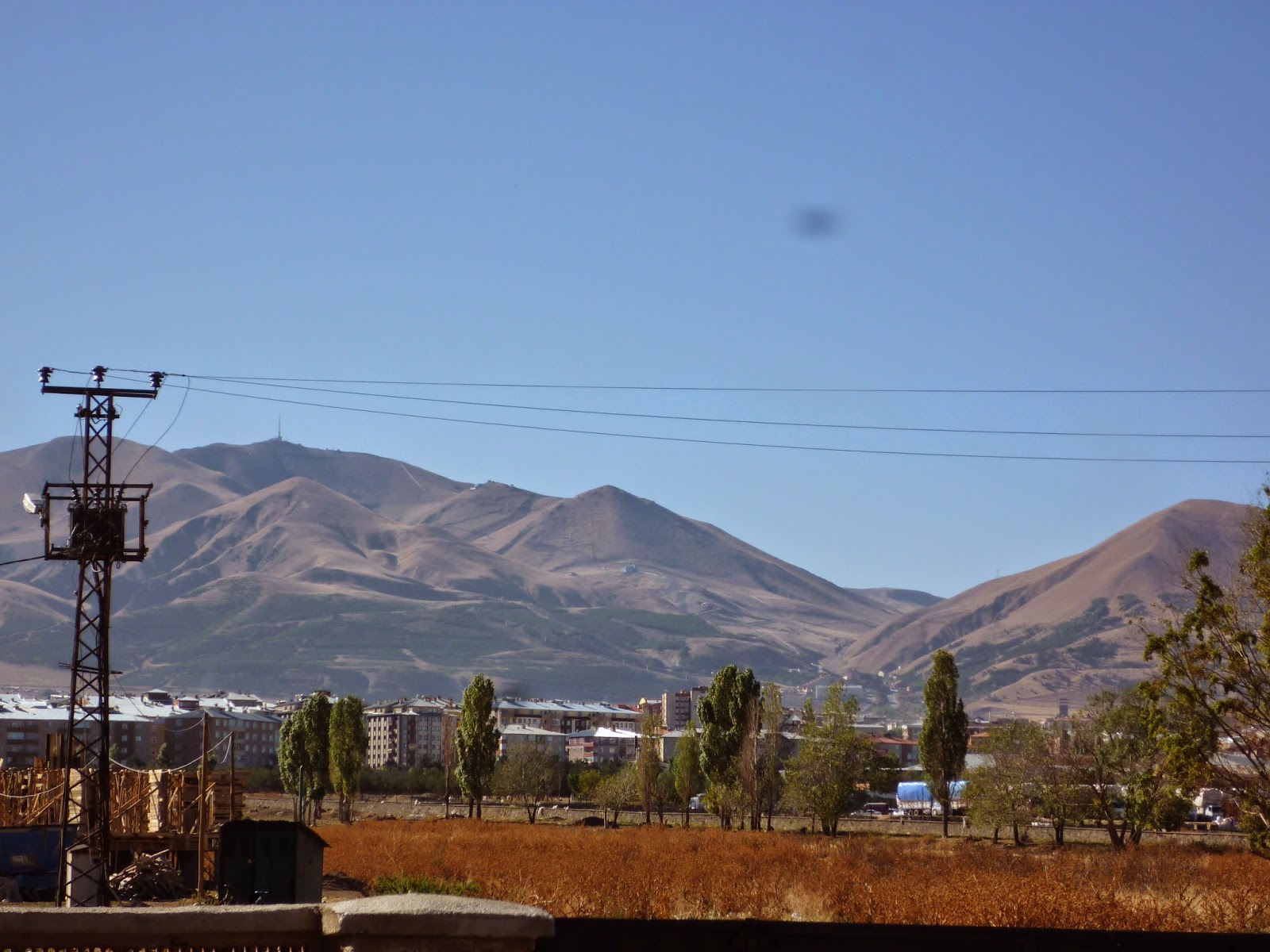
On the third day it's once more time to leave. I wake up early and walk around in the garden taking pictures of the huge landscape all around:
We pass by a truck that just fell off the road on that same day and turned over. When we take a break on a newly built, not yet fully functioning gas station I enjoy the crisp clear mountain air, chilly and dry for a change. The break, however, turns into a repair stop about five men take turns looking under the buses hood, but it doesn't seem to work. I have a fight with my phone which is erratically disconnecting and reconnecting, finally I manage to message my host in Erzurum. After about an hour we continue the trip. At some minor stop in the middle of this massive nowhere the conductor makes me change the bus and some hours late I arrive at Erzurum's modern bus station.
My hosts show me a bit of the town by car and invite me for traditional Turkish lunch to a restaurant. Although only one of them speaks English we easily find a lot to talk about and are soon deep in conversation about German politics, Turkish food, soccer, the landscape and many other things. I am truly grateful for the kind and generous hospitality, especially after the long bus ride and not understanding where I was going.
The guys I'm staying with are really sweet and show me around the town which is an important army base and university in this part of the country and they always worry if everything is fine - it sure is! They even help me get my camera fixed, so here are some pictures of the central square and one of the old mosques, quite different from those in Istanbul.
The days are still hot and we just take a brief look at the busy life downtown before sitting in the shade outside the university eating sunflower seeds and talking about politics, patriotism, culture and modernity, religion and family values. Such a lot of world to see!
The nights are pleasantly mild, so me mostly walk after dark, have delicious ice cream and visit the Taşhan, an old trading house that contains loads of tiny shops selling jewelry made from the black stone (black kind of amber), the Oltu Taş.
I wonder why there are ski jumpers decorating most of the street lamps on the bigger streets. They seem a bit out of place at these temperatures, but I can well imagine that it gets very cold round here in winter. And yes, there are ski jumps here, I can see them in the distance behind the university compounds. In 2011 the XXVth Winter Universiade were held here, something like Olympic Games for university athletes, I never heard of it before, the city is still proud of this event. There is something going on in this far Eastern corner of the country after all. I do see it is a very different part and a very distant place from most other parts of Turkey. My host points out that he definitely views himself as an Asian. People in Western Turkey might identify with Europe to some extent, for him that wouldn't make any sense whatsoever. He has seen four other cities in Turkey and never left the country, so he uses Couchsurfing to improve his English (and German and Russian to some extent) and learn as much about other places as possible by talking to his guests and reading on the internet. It humbles me to be welcomed with such hospitality and openness by someone to whom I cannot offer the same in return as he cannot afford travelling - for now, hopefully that will change in the future...
On the third day it's once more time to leave. I wake up early and walk around in the garden taking pictures of the huge landscape all around:
Crazy Night Bus and Blue Black Sea: Trabzon
After nearly a week in the metropolis my plan to head East is set. Ivana helps me to get a ticket for the night bus to Trabzon more than 1000km along the Black Sea coast, I get a confirmation from my Couchsurfing host in Erzurum where I will go after that and I bought a LOT of Turkish delight. My farewell experience is smoothly slipping through major traffic chaos by a giant portion of good chance.
I don't want to hurry with my heavy backpack and I don't know exactly how long it will take me to walk from the hostel to Taksim for the shuttle to the bus company's central station, so I leave hours early, get a kumpir on my way for dinner and unexpectedly find myself in the six o'clock shuttle instead of the seven o'clock one. Traffic jam is the natural condition of Istanbul streets, but today something is just not right. It takes us more than two hours instead of one to get to the main station at the highway. Most people on my bus thus missed their long-distance connection. I feel quite lost on the huge dusty yard overcrowded with people, bags, and buses. No one speaks English, someone manages to gesture to me I just have to check the number on the bus to find mine. I find some teenagers who do speak English, they confirm that my bus will leave on this side of the yard, not on the opposite side 70 meters away, out of sight. It's already nearly an hour late and I start to get quite nervous. I hear a man in a white shirt say something about Erzurum to someone and I show him my ticket. He beams at me, oh, yes, that's right! I have to come with him! He takes me and the other guy with him, hurrying between heaps of sand, stones and concrete: Our bus has already left and he is the conductor looking for the two missing passengers! We hop on board while the bus is slowly making it's way back onto the overcrowded city highway. Praise to the well organized Turkish long-distance buses. (You have to reserve your seat to your name, including your gender. Men and women are not allowed to sit next to each other.) You also get fed all the time. Tea. Biscuits. Tea. Ice cream. Water. Nuts. Tea. Within two hours. I fall asleep shortly after midnight. I wake up briefly at 4 am. When the clock doesn't show the time it informs me about the temperature of the dark grey landscape outside with steep stones on both sides of the road: eleven degrees centigrade.
After having brushed my teeth at a highway stop the next morning and spending some ten minutes in the sun enjoying the chilly morning air while our bus is washed, too, I get to know a new type of coastline. The highway is practically next to the beach, there is the Black Sea to my left for some hours. It is very dark blue and very detached from the land and humans as the narrow strip of brown sand is wedged between the water and the highway. Quite a distant sea...
We arrive at Trabzon in the early afternoon. It's quite easy to get the dolmush to the center, but I am a bit disoriented and walk around a lot in the heat before I find the pension mentioned in the Lonely Planet. The rooms are very tiny, very brightly colored, very tidy and everything smells of chlorine. My window also faces the mosque with the very loud muezzin mentioned in the book. I don't mind, he won't call when I'll go to bed and once I'm asleep even he won't be able to wake me up.
Unfortunately I don't have time to take the tour out of town to visit e mountain monastery, so I just walk around the city center and explore this down to earth harbor city. It is quite a contrast after Istanbul, modest, small, no tourists. I stroll thorough the market quarter. Having forgotten my scarf I buy a nice simple bluish grey one for two Lira to be able to visit one of the beautiful mosques. I manage to buy a small box containing about a hundred hair pins for a similar amount of money and a half of a huge loaf of freshly baked bread directly from the window of the bakery. I feel like I got what I need for the rest of this trip.
For the first time since I left Srebrenica it starts to rain heavily, so I spend some time in an internet cafe, verifying my schedule for the following day and writing some emails. Later I meet my train and Istanbul buddies and some friends of their's. They stopped here for some days on their way to Georgia and made use of the low prices for clothes. It's really great to exchange some more views of Turkey and get some valuable information about Georgia. And as my phone is really starting to fail me they even lend me their spare phone (I returned it on New Year's when we all happened to celebrate in Dresden, Germany)!
- Unfortunately my camera broke so I don't have any pictures of this part of the trip. -
I don't want to hurry with my heavy backpack and I don't know exactly how long it will take me to walk from the hostel to Taksim for the shuttle to the bus company's central station, so I leave hours early, get a kumpir on my way for dinner and unexpectedly find myself in the six o'clock shuttle instead of the seven o'clock one. Traffic jam is the natural condition of Istanbul streets, but today something is just not right. It takes us more than two hours instead of one to get to the main station at the highway. Most people on my bus thus missed their long-distance connection. I feel quite lost on the huge dusty yard overcrowded with people, bags, and buses. No one speaks English, someone manages to gesture to me I just have to check the number on the bus to find mine. I find some teenagers who do speak English, they confirm that my bus will leave on this side of the yard, not on the opposite side 70 meters away, out of sight. It's already nearly an hour late and I start to get quite nervous. I hear a man in a white shirt say something about Erzurum to someone and I show him my ticket. He beams at me, oh, yes, that's right! I have to come with him! He takes me and the other guy with him, hurrying between heaps of sand, stones and concrete: Our bus has already left and he is the conductor looking for the two missing passengers! We hop on board while the bus is slowly making it's way back onto the overcrowded city highway. Praise to the well organized Turkish long-distance buses. (You have to reserve your seat to your name, including your gender. Men and women are not allowed to sit next to each other.) You also get fed all the time. Tea. Biscuits. Tea. Ice cream. Water. Nuts. Tea. Within two hours. I fall asleep shortly after midnight. I wake up briefly at 4 am. When the clock doesn't show the time it informs me about the temperature of the dark grey landscape outside with steep stones on both sides of the road: eleven degrees centigrade.
After having brushed my teeth at a highway stop the next morning and spending some ten minutes in the sun enjoying the chilly morning air while our bus is washed, too, I get to know a new type of coastline. The highway is practically next to the beach, there is the Black Sea to my left for some hours. It is very dark blue and very detached from the land and humans as the narrow strip of brown sand is wedged between the water and the highway. Quite a distant sea...
We arrive at Trabzon in the early afternoon. It's quite easy to get the dolmush to the center, but I am a bit disoriented and walk around a lot in the heat before I find the pension mentioned in the Lonely Planet. The rooms are very tiny, very brightly colored, very tidy and everything smells of chlorine. My window also faces the mosque with the very loud muezzin mentioned in the book. I don't mind, he won't call when I'll go to bed and once I'm asleep even he won't be able to wake me up.
Unfortunately I don't have time to take the tour out of town to visit e mountain monastery, so I just walk around the city center and explore this down to earth harbor city. It is quite a contrast after Istanbul, modest, small, no tourists. I stroll thorough the market quarter. Having forgotten my scarf I buy a nice simple bluish grey one for two Lira to be able to visit one of the beautiful mosques. I manage to buy a small box containing about a hundred hair pins for a similar amount of money and a half of a huge loaf of freshly baked bread directly from the window of the bakery. I feel like I got what I need for the rest of this trip.
For the first time since I left Srebrenica it starts to rain heavily, so I spend some time in an internet cafe, verifying my schedule for the following day and writing some emails. Later I meet my train and Istanbul buddies and some friends of their's. They stopped here for some days on their way to Georgia and made use of the low prices for clothes. It's really great to exchange some more views of Turkey and get some valuable information about Georgia. And as my phone is really starting to fail me they even lend me their spare phone (I returned it on New Year's when we all happened to celebrate in Dresden, Germany)!
- Unfortunately my camera broke so I don't have any pictures of this part of the trip. -
Mittwoch, 5. März 2014
Glimpses of Istanbul (Istanbul III)
Thursday is the day of free admission to the modern art museum Istanbul Modern
- not for non-residents, though. I decide to buy a ticket and although I don't
know all that much about modern art I enjoy the different exhibitions of modern
Turkish artists. When I have to leave I spend some more time in the yard, a
stone garden looking out to the Bosporus and decorated with some entries to a
recent architecture competition. One of them transports the movements of the
water underneath to metal circles looking like slender giant mushrooms. The sun sets gleaming on the by passing ships and the
opposite shore.
Politics are not as obviously heated as in late May when Taksim and Gezi Park dominated breakfast conversations in the partly Turkish team of the psychiatric clinic in Berlin I did my internship at. But even without previous experience and with very little knowledge of this city I recognize some signs of public activism. One day I happen to run across one of the long stairs leading up from the Bosporus painted in rainbow colors. On the next day I start to question my sense of orientation when I cannot find it. Later I learn that it had been painted illegally by citizens not willing to wait any longer for the city council to do something about street repair. There is a heated discussion about the boundaries of personal freedom and public property and at some point the stairs were painted grey again. There is a lot of police in the side streets of Istiklal, the avenue leading to Taksim Square, and the square itself...
I spent one day taking the ferry (not a tourist boat, but a regular part of public transportation as I know it from Hamburg) up the Golden Horn and visiting some sights along it, first the complex of Eyüp Sultan Mosque where I see many dressed up little boys in white glittery uniforms accompanied by there families to celebrate their upcoming circumcision. The huge cemetery extending up the hill towards the Pierre Lotfi café is a very popular destination for families, as well. The view of both the graves and over the Horn is quite spectacular - and I spend at least half an hour in the queue for the cable car back down to the ferry.
At a stop on the other side of the water I try to follow another of my
German-Turkish friend's recommendations. Getting to Santralistanbul, however, proves to be difficult without speaking
Turkish, but I make it! This industrial complex next to Bilgi University used
to be the first urban power plant of the Ottoman Empire and supplied the city
with energy from 1911 through 1983. Now it holds both the Energy Museum and
halls for art exhibitions. Right now there is no exhibition and university
hasn't started yet either, so the place is quite deserted expect for a few
students out on the lawns and a receptionist and two security guys at the
museum, none of whom speaks a word of English. So I walk the halls all on my
own and get carried away with taking photos of the gigantic steel instruments.
It does feel a bit creepy. But definitely worth a trip:
Getting back to Taksim gives me some tension, too, as darkness falls quickly and I once again have to find the right bus in spite of the language barrier and the absence of any signs. It's always an exhilarating mix of triumph (of having made it) and gratitude (of never having to make it quite on my own) and finally relaxation of returning to a more familiar area which in contrast feels ever so much like home.
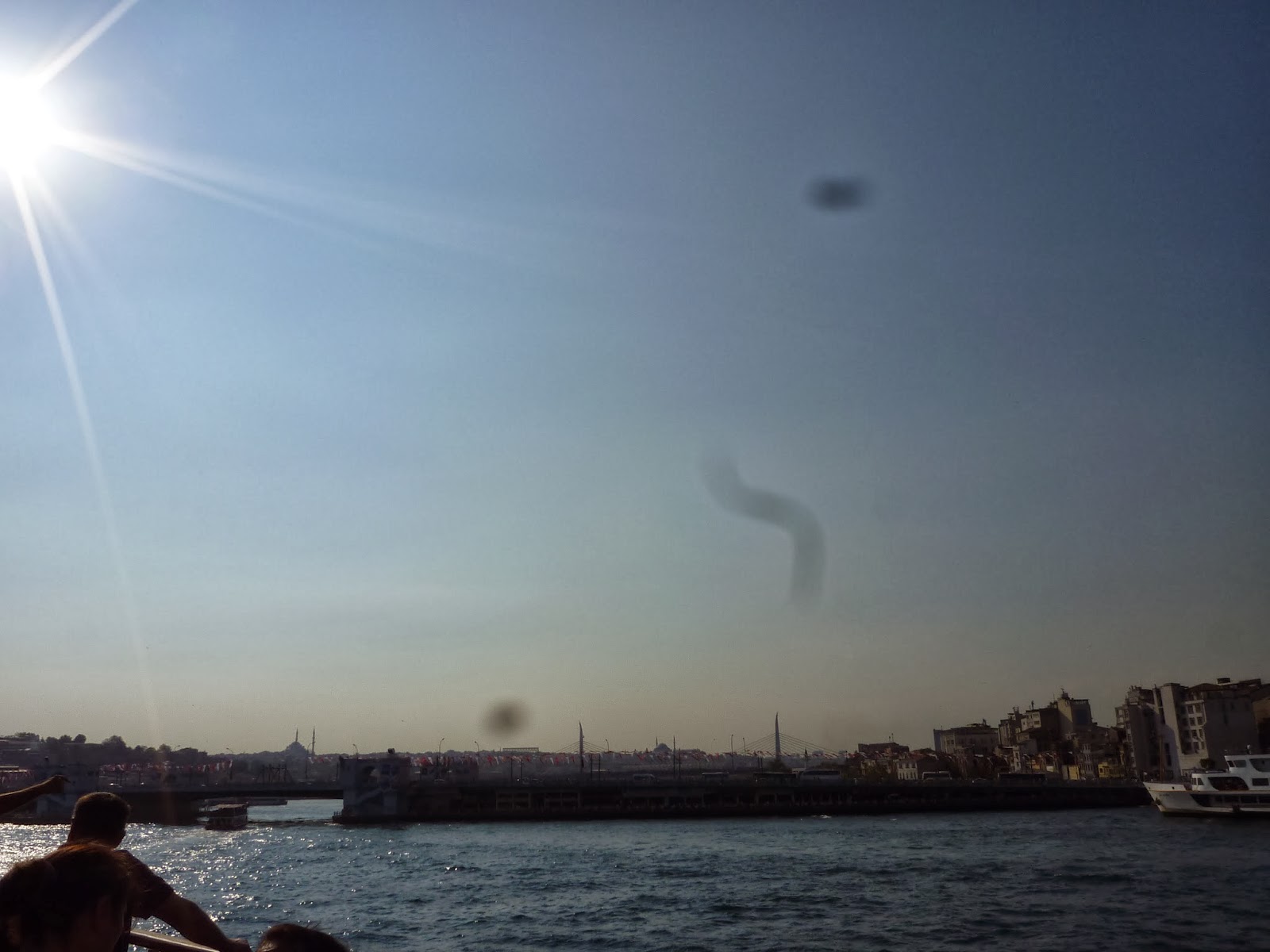
One afternoon I also take a ferry to see some more of the Bosporus, of course. I always love being on a ship and even without knowing much about what exactly I see on the shores it is a great and relaxing way to spend two hours. Probably more relaxing in my state of information overload than opting for the audio guide...
After some discussions my train buddies and I also find a day to visit Hagia Sophia and the
Blue Mosque together (didn't manage to see Topkapi though, well, I
guess I'll be back ;)). Both monuments are quite crowded, but surprisingly I
don't feel like it disturbs the atmosphere for me. Both the buildings and the
decorations and mosaics are huge and impressive and in some way perfect, but once more I find I
have too much imagination, they don't seem new to me although I've never even
seen that many pictures... Still, a must see, no doubt about that.
After having walked around a lot, taken pictures (and - typically German - marvelled at people unable to adhere to signs not to flash) I sit outside on the stairs in silence, waiting for the others taking a look around the yard which I saw before entering. The unlikely rain we only saw from the inside has stopped and the warm stone is dry again. A slender cat sneaks up to me, I play with her for a while in spite of her questionable cleanliness. Perfect peace and quiet in the very middle of Istanbul.
Abonnieren
Posts (Atom)