Very short post, but this trip makes me see it even more clearly than all by dealing with it before, be it professionally trying to help people make sense of their life stories, reading novels and biographies in my free time, sharing and exchanging perspectives on major and minor historical events, trying to open my students' eyes for them, it's really all about STORIES.
Be it in taking a photo or writing a scientific paper, be it in politics or medicine. It's about finding the story, that is, making it visible for others, share it, get it across. Hıstory and her story, our story and their story. Your stories! My stories!
As stories are condensed realities, tangible truths.
Donnerstag, 29. August 2013

Big City Bosnia: Sarajevo
After a quite exhausting night bus trip - no air conditioning, exceptionally narrow seats, some drunk passangers - I just sit in the hall of the central bus station for a long while, have breakfast and finish my book. Eventually I feel up to findıng my tram and a ticket and the hostel rıght in the center of the city, just two streets off the river Miljacka and the bridge where Franz Ferdinand was assassinated 99 years ago. The hostel ıs called Residence Rooms and the height of the rooms is certainly residential. The atmosphere is cozy and welcoming, although it is quite big, another family run place. While waiting for my room I talk to the owner, a great lady fluent in many languages, about how there are still differences between the eastern and western parts of Germany - and how she thinks Yugoslavia was better before the change.
In the afternoon I find a small guide book in the living room and set out to explore the surroundings in the blazing sunlight that sometimes is even stronger than my sun-glasses. Although it is not as hot as in Mostar my ice-cream consumption peaks here (after preaching for weeks to the parents at the pediatrist's practice to only buy packaged ice-cream in warm climate... ;))

I instantly like Sarajevo, after having been in Mostar and some places in Kosovo which felt quite different, I think I can say there is something like a specific Bosnian atmosphere that I recognize also in this much bigger city. In the old town district of Baščaršija and its surroundings the Turkish influence mixing with Slavic and Austro-Hungarian elements is especially visible and I am looking forward to visiting Turkey itself quite soon. The Gazi Husrev-bey Mosque is one of the most beautiful mosques I know with a calm and happy atmosphere filling the yard with a magnificent fountain in the middle of the bustling old town.
Later I walk up to the Srvzo family's house, a museum displaying the taste and comfort of the Sarajevo upper class during Ottoman times.

The main streets and tiny alleys between the low buildings bustle with visitors considering souvenirs, eating ice-cream and drinking Bosnian coffe in one of the small cafes. There are quite a lot of veiled women, but even more with sIeeveless tops. No pressure to restrain one's clothing in this Muslim country, very relaxing. For more relaxing after much walking in the sun I choose a yard cafe to have a Bosnian coffee - don't even mıss my black tea all that much. The main streets leading away from the old town get really busy only later in the evening when people in groups, pairs, families get out to enjoy the summer with less heat and sun, but as cheerfully as in the afternoon in Baščaršija.

On the next day I join the senior hostel owner's tour dealing mainly with more recent aspects of Sarajevo's history. At the center of the tour is the siege Sarajevo suffered for nearly four years. After we visited the Jewish cemetery he shows us a rock with a great view of the city in the valley, streching nto the hills. Handing us a pair of binoculars he adds, see, this was the view the snipers had, you can distinguish people down there in the street. Weird feeling. Once more this tour is a mix of history and personal story, in this case starting in WWII. I will need many more stories to get a 3D picture...
Before we visit the museum of the tunel that served as a life support during the siege, we visit another building that could be called at least half a tunnel: The ruins of the olympic bob sleıgh run, now a kind of open air graffitti gallery in the forest that had to be demined in order to be used as a get away from the city again.


Together with three other guests from the hostel - two of them Americans - I finish the day at the soccer friendly Bosnia-Hercegovina against the USA. The tıckets cost five Euros, we take along a Bosnian flag, a Bosnian scarf - and a US jersey. Bosnia starts out well and apart from sıdeway glances no one mınds the obvıuos American. After a while, however, the game turns and so does the audıence's mood. People even start to leave before the game ıs over. Still, I enjoyed the fırst match of national teams I saw so far. And so did the Bosnıan-American grandson of the hostel owner.

In the afternoon I find a small guide book in the living room and set out to explore the surroundings in the blazing sunlight that sometimes is even stronger than my sun-glasses. Although it is not as hot as in Mostar my ice-cream consumption peaks here (after preaching for weeks to the parents at the pediatrist's practice to only buy packaged ice-cream in warm climate... ;))

I instantly like Sarajevo, after having been in Mostar and some places in Kosovo which felt quite different, I think I can say there is something like a specific Bosnian atmosphere that I recognize also in this much bigger city. In the old town district of Baščaršija and its surroundings the Turkish influence mixing with Slavic and Austro-Hungarian elements is especially visible and I am looking forward to visiting Turkey itself quite soon. The Gazi Husrev-bey Mosque is one of the most beautiful mosques I know with a calm and happy atmosphere filling the yard with a magnificent fountain in the middle of the bustling old town.
Later I walk up to the Srvzo family's house, a museum displaying the taste and comfort of the Sarajevo upper class during Ottoman times.

The main streets and tiny alleys between the low buildings bustle with visitors considering souvenirs, eating ice-cream and drinking Bosnian coffe in one of the small cafes. There are quite a lot of veiled women, but even more with sIeeveless tops. No pressure to restrain one's clothing in this Muslim country, very relaxing. For more relaxing after much walking in the sun I choose a yard cafe to have a Bosnian coffee - don't even mıss my black tea all that much. The main streets leading away from the old town get really busy only later in the evening when people in groups, pairs, families get out to enjoy the summer with less heat and sun, but as cheerfully as in the afternoon in Baščaršija.

On the next day I join the senior hostel owner's tour dealing mainly with more recent aspects of Sarajevo's history. At the center of the tour is the siege Sarajevo suffered for nearly four years. After we visited the Jewish cemetery he shows us a rock with a great view of the city in the valley, streching nto the hills. Handing us a pair of binoculars he adds, see, this was the view the snipers had, you can distinguish people down there in the street. Weird feeling. Once more this tour is a mix of history and personal story, in this case starting in WWII. I will need many more stories to get a 3D picture...
Before we visit the museum of the tunel that served as a life support during the siege, we visit another building that could be called at least half a tunnel: The ruins of the olympic bob sleıgh run, now a kind of open air graffitti gallery in the forest that had to be demined in order to be used as a get away from the city again.


Together with three other guests from the hostel - two of them Americans - I finish the day at the soccer friendly Bosnia-Hercegovina against the USA. The tıckets cost five Euros, we take along a Bosnian flag, a Bosnian scarf - and a US jersey. Bosnia starts out well and apart from sıdeway glances no one mınds the obvıuos American. After a while, however, the game turns and so does the audıence's mood. People even start to leave before the game ıs over. Still, I enjoyed the fırst match of national teams I saw so far. And so did the Bosnıan-American grandson of the hostel owner.

Mittwoch, 28. August 2013
Kosovo Again
Before taking the night bus back to Sarajevo I use the last half day to visit Gračanica, a monastery and vıllage outside of Prishtine. The monastery is an important example of Byzantıne architechture in the region, the village has more or less turned into a Serbian enclave, including an office issuing Serbian passports and the like. On the bus I talk to a man who learned his close to perfect German - he even translated for the German Police in Kosovo - solely by watching satellite TV. He tells the driver to stop at the monastery for me, not necessarily a welcome stop...
The monastery is beautiful and silent despite of quite a few visitors and tourists (I am the only one abiding by the 'no photos' signs...). It is quite dark inside and the nuns are friendly, but shy. A withdrawn place.
When I'm back ın the city I take a last walk to see some parts beyond the boulevard I haven't seen so far, so I enter the old town. As ın many other places there are mosques being restored by the Turkish government and also some other construction work going on. What I find most typical about this quarter, however, is the combination of European architecture with an oriental maze of winding paths and streets, everythıng, of course, once more covered in the spider web of electricity lines. I cross a grocery street market wıth mny old men wearing traditional white Albanian felt hats. And all of a sudden I am back at the main road again.
Time to get ready to leave.


The monastery is beautiful and silent despite of quite a few visitors and tourists (I am the only one abiding by the 'no photos' signs...). It is quite dark inside and the nuns are friendly, but shy. A withdrawn place.
When I'm back ın the city I take a last walk to see some parts beyond the boulevard I haven't seen so far, so I enter the old town. As ın many other places there are mosques being restored by the Turkish government and also some other construction work going on. What I find most typical about this quarter, however, is the combination of European architecture with an oriental maze of winding paths and streets, everythıng, of course, once more covered in the spider web of electricity lines. I cross a grocery street market wıth mny old men wearing traditional white Albanian felt hats. And all of a sudden I am back at the main road again.
Time to get ready to leave.

People...

...and government

Montag, 26. August 2013
Crazy Canyon: Macedonia
It was meant to be a relaxing weekend with two of my friend's colleagues, sharing activities like kayaking and swimming at some lake in a canyon in the Macedonian mountains, namely the lake Matka, formed by the hydroelectric dam Matka I. It did not work out quite that way, but still we are glad we came and there will be many things to remember about this trip. Having taken some food for the drive we create the term border-crossing cheese balls as we eat those while waiting at the check point. As expected, no problems here and yes, we are diplomatic!
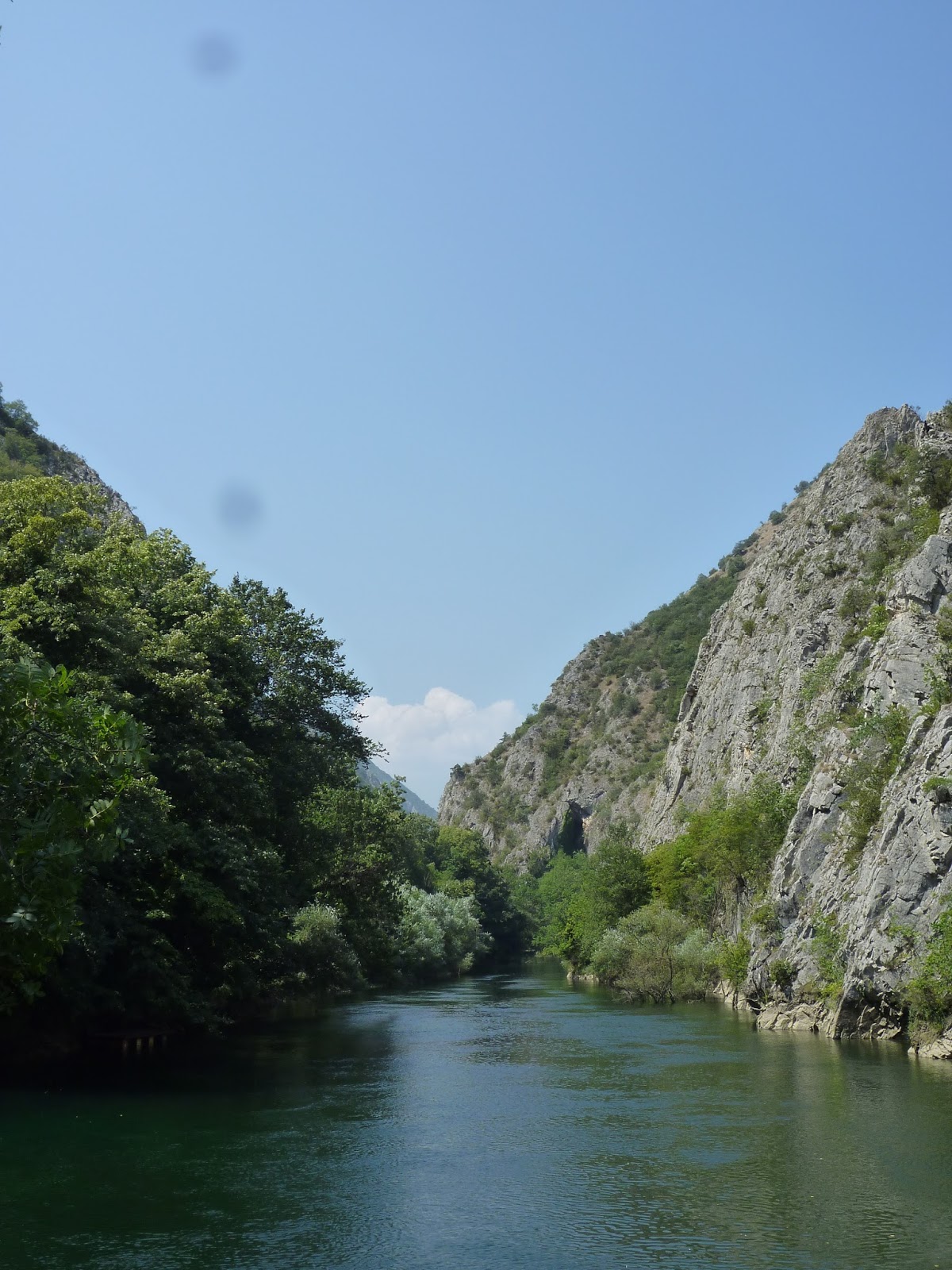
The instructions how to reach the hotel are a bit enigmatic, but we finally make it. A small hotel directly at the lake, big terrace, great view from the rooms (when they are finally ready) and an Orthodox chapel right next door. But we already see the threat to our peaceful and quiet evening: The hotel is preparing for a wedding! Well. But it's only noon, so we get two two-seated plastic kayaks and set out up-stream, always chasing the answer to the question of what lies behind the next corner. The lake turns out to form an even curve, so it's new similar great views, the path on the rock some ten meters above on the one side and some huts on the more level other side. After some good kayaking (or drifting...) we are quite hungry and after being shown where we can and where we can't eat by some rather surly young waiter we enjoy big bowls of chopska, the local salad (chopped tomatoes - those alone are worth a trip! - and cucumbers covered in white cheese). The afternoon passes pleasantly with reading, talking about books and some wine.

When we start thinking about dinner, the first wedding guests arrive. The quite long and cobbled walk from the parking lot puts strain even on the most skilled owner of 10cm heels. We marvel at the brightly colored dresses and hair styles of some female guests (and the less than happy look on the face of the bride). While the surly young man serves us dinner the party on the main terrace starts. The DJ plays a mix of traditional songs and 80s and 90s (including 'Time to Say Goodbye'...), the bride's mood however seems to improve and so does the volume of the music.
Even with closed windows it's loud enough for a party in our rooms, someone didn't plan this too well. I fall asleep anyway, two of the others, however, don't and they don't feel all that diplomatic anymore, either.
In the morning we manage to get a deal granting all of us another free night and the possibility to use the showers once more after having checked out today, so we can do some more canyon activities. First we visit a recently discovered cave upstream. It is quite cold inside and there is a lake and many bats! On the way back the guide manages to explain that the huts along the lake belong to Tarzan and Jane - or maybe just to some fishermen... Later we climb up a very steep path to a small monastery looking quite exactly like the chapel next to the hotel on the opposite side of the canyon. When we get back and are handed the keys to one of the rooms to shower, it turns out the whole building is without water... Well, what can you do. The crew can use a fire hose to get water from the canyon to do at least some rough cleaning and nearly floods our bags. But just nearly.

We leave in an amused mood, passing giant flags and statues on our way through the outskirts of Skopje. At the border we meet a strange sight. While there is a quite modest Kosovo flag on top of the check point building, a tiny shop right behind it (on Kosovo side) flies a giant Albanian flag... For the first time we get thoroughly interrogated about everyone's reasons for being in Kosovo. Maybe a new guy... We slowly get back to Prishtine, once more trying to adapt to the somewhat erratic Kosovar driving style. Once a driver is talking on the phone or even only to his neighbor he seems to be unable to go faster than 50km/h. You never stop learning in a new place...
The instructions how to reach the hotel are a bit enigmatic, but we finally make it. A small hotel directly at the lake, big terrace, great view from the rooms (when they are finally ready) and an Orthodox chapel right next door. But we already see the threat to our peaceful and quiet evening: The hotel is preparing for a wedding! Well. But it's only noon, so we get two two-seated plastic kayaks and set out up-stream, always chasing the answer to the question of what lies behind the next corner. The lake turns out to form an even curve, so it's new similar great views, the path on the rock some ten meters above on the one side and some huts on the more level other side. After some good kayaking (or drifting...) we are quite hungry and after being shown where we can and where we can't eat by some rather surly young waiter we enjoy big bowls of chopska, the local salad (chopped tomatoes - those alone are worth a trip! - and cucumbers covered in white cheese). The afternoon passes pleasantly with reading, talking about books and some wine.
When we start thinking about dinner, the first wedding guests arrive. The quite long and cobbled walk from the parking lot puts strain even on the most skilled owner of 10cm heels. We marvel at the brightly colored dresses and hair styles of some female guests (and the less than happy look on the face of the bride). While the surly young man serves us dinner the party on the main terrace starts. The DJ plays a mix of traditional songs and 80s and 90s (including 'Time to Say Goodbye'...), the bride's mood however seems to improve and so does the volume of the music.
Even with closed windows it's loud enough for a party in our rooms, someone didn't plan this too well. I fall asleep anyway, two of the others, however, don't and they don't feel all that diplomatic anymore, either.
In the morning we manage to get a deal granting all of us another free night and the possibility to use the showers once more after having checked out today, so we can do some more canyon activities. First we visit a recently discovered cave upstream. It is quite cold inside and there is a lake and many bats! On the way back the guide manages to explain that the huts along the lake belong to Tarzan and Jane - or maybe just to some fishermen... Later we climb up a very steep path to a small monastery looking quite exactly like the chapel next to the hotel on the opposite side of the canyon. When we get back and are handed the keys to one of the rooms to shower, it turns out the whole building is without water... Well, what can you do. The crew can use a fire hose to get water from the canyon to do at least some rough cleaning and nearly floods our bags. But just nearly.

We leave in an amused mood, passing giant flags and statues on our way through the outskirts of Skopje. At the border we meet a strange sight. While there is a quite modest Kosovo flag on top of the check point building, a tiny shop right behind it (on Kosovo side) flies a giant Albanian flag... For the first time we get thoroughly interrogated about everyone's reasons for being in Kosovo. Maybe a new guy... We slowly get back to Prishtine, once more trying to adapt to the somewhat erratic Kosovar driving style. Once a driver is talking on the phone or even only to his neighbor he seems to be unable to go faster than 50km/h. You never stop learning in a new place...
Culture Shock And Prizren: More Kosovo
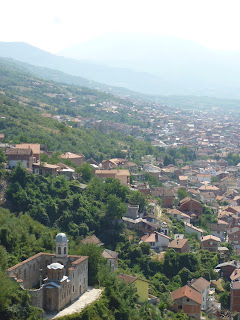
After having been very sick on Bayram I set out to Prizren while my friend has a short Friday at the embassy to complete. The walk to the central bus station gives me the first culture shock on this trip. I am on my own again and quite different from Slovenian or Croatian/Bosnian/Serbian Albanian sounds - and looks - completely foreign, inevitably jumping at me in bold Latin writing from every direction. some bald display dummies in bright glittery dresses angrily stare at me from a shop window. I take refuge in one of the many bakeries filled with the delicious smell of soft fresh white bread and rolls filled with poppy seed or jam. I am already exhausted when I reach the bus. The bus ride, some food and blue berry lemonade, however, give me time to recollect myself and so I leave the bus in a cheerful mood in Prizren. The map in the guide book only roughly indicates the direction from the city center to the bus stop, so I take a look at the sun, at the flow of the traffic and soon find myself at the Lumbardhi (or Bistrica), the river that runs through the center of the city. A bunch of rather old and short German KFOR soldiers in camouflage, but clearly on a sightseeing trip tumble out of a bus at one of the main bridges. I take the walk around the old town as the guide book suggests it and Prizren really is the gem of Kosovo. Unfortunately quite some of the bautiful old buildings such as the old hammam are out of use and in need of restoration. In the case of mosques the Turkish government helps a lot.

I don't know if it is because it is still Bayram or because of the heat, in the evening the cafes around the central square will probably be bustling with young people, I see them getting ready when I am back on the bus later. As I continue my walk I learn something about the League of Prizren, an Albanian political organization fighting for Albanian autonomy in the late 19th century which is also referred to in many "1878" graffitti all over the city. Co-existence was never all that easy, not even in earlier days of wide-spread trilingualism.
When I walk up to the fortress the path leads past the relics of the last victims of inter-ethnic hatred: The former Serbain quarter was destroyed in 2004 and lies deserted in the blazing sun. Once more international troops were unable to keep the non-existent peace here...
On the bus ride back to Prishtine I notice for the first time the quite homogenous infrastructure along the roads: car washing, car repair, furniture, building material and, like in one street in Prizren solely dedicated to these shops, huge glittery wedding dresses. A young country.
When I return I am able to enjoy my walk back, happy not to constantly need a map anymore, knowing when to expect a smile and wave from Bill Clinton and even the bald dummies look more friendly than in the morning. For dinner we find a lovely vegetarian restaurant, that probably owes its existence mainly to the expat community and next to it a happily chaotic book shop worth coming back to - if one has space for more books to carry.


I don't know if it is because it is still Bayram or because of the heat, in the evening the cafes around the central square will probably be bustling with young people, I see them getting ready when I am back on the bus later. As I continue my walk I learn something about the League of Prizren, an Albanian political organization fighting for Albanian autonomy in the late 19th century which is also referred to in many "1878" graffitti all over the city. Co-existence was never all that easy, not even in earlier days of wide-spread trilingualism.
When I walk up to the fortress the path leads past the relics of the last victims of inter-ethnic hatred: The former Serbain quarter was destroyed in 2004 and lies deserted in the blazing sun. Once more international troops were unable to keep the non-existent peace here...

On the bus ride back to Prishtine I notice for the first time the quite homogenous infrastructure along the roads: car washing, car repair, furniture, building material and, like in one street in Prizren solely dedicated to these shops, huge glittery wedding dresses. A young country.
When I return I am able to enjoy my walk back, happy not to constantly need a map anymore, knowing when to expect a smile and wave from Bill Clinton and even the bald dummies look more friendly than in the morning. For dinner we find a lovely vegetarian restaurant, that probably owes its existence mainly to the expat community and next to it a happily chaotic book shop worth coming back to - if one has space for more books to carry.

No to negotiations
HALF TIME
I know I am way behind with my posts, but hoping to catch up... Still I break the chronology for this post - and the change of the header photo - as I just realized that yesterday and today are the middle days of my trip, day 27 and 28 out of 54. It feels like I left Ahrensburg a really long time ago. So many new impressions, great people I am so glad to have met in every single place I stayed, so much I learned, about the place and about the world on the whole, so much time to just walk or sit, catching pictures and thoughts. When I was in Belgrade last week, I realized I couldn't yet take two night trains and hit the 15 million metropolis of "far-off, shining and terrible Stambul" as Ivo Andrić puts it in his Nobel Prize winning novel The Bridge on the Drina (more about that later), although I would probably replace "terrible" with "huge and noisy". My health was a bit down and my mind needed a break, too, so I returned to Srebrenica, even for four days which was definitely the right decision. Mosque and church towers and green mountains, the view of Srebrenica from the ascend to the old town wall is a nice wrap up of one of my main impressions from the Balkans and a picture from a place to recover in between visiting all the big cities.
So here I am after four weeks in what used to be Yugoslavia, back to Belgrade, bought the ticket for the first night train (from a friendly and competent officer fluent in at least three languages!) and ready for Istanbul, or so I think...
So here I am after four weeks in what used to be Yugoslavia, back to Belgrade, bought the ticket for the first night train (from a friendly and competent officer fluent in at least three languages!) and ready for Istanbul, or so I think...
Getting to And Being In Kosovo
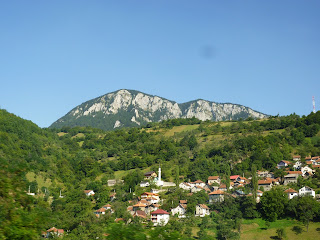
I really don't need books or anything for day-time travel in the Balkans - the view from the bus windows is nearly always worth trying to get a glance at it, even when everyone else rather closes the curtains against the sun. Coming from Northern Germany and having spent my childhood vacations at the North Sea I've never been much of a mountain person, but the Balkans actually intrigue me, wild and green with many turquoise rivers deep down in steep valleys cut into the stone. The way from Mostar to Sarajevo offers many spectacular views and numerous European villages each with a small mosque. So, what is this discussion if Islam belongs to Europe about anyway?

There is a four hours lay-over in Sarajevo, I am tired and spend it in the hall of the central bus station, reading. The room looks strangely fallen out of time, 1970s' architecture including dark wood panels, some abstract wall decoration and the Sarajevo '84 snowflake (emblem of the winter Olympics) and script prominently placed over the central clock. I am a bit worried about the night bus, but it turns out to be quite a family trip. And both Serbian and Kosovar border officials accept my ID card for crossing the border, so, no stamps, no trouble. After collecting the documents and taking them to their office for some time, the border policeman hands them back to the conductor who then calls out the passengers' names, always interesting if they call the foreigners by first or last name and if the English native speakers recognize themselves. I usually get some special German greeting...
After two borders and changing the bus during the night I am not exactly awake when I reach Prishtine at eight in the morning, but I manage to get a taxi to the German embassy and even get in there to meet my friend who works there. She lets me into her home and returns to work, so I have some time to get organized and relax until we meet for lunch in a nice restaurant close to the embassy. As Kosovo uses the Euro the in Western European eyes favorable prices are not even obscured by conversion. On the way back I am able to take in some more details of the surroundings. Many houses and apartments along the steep streets are for rent as diplomats are not longer restricted to live in this area. Electricity seems to be distributed by a pattern of cables that remind me of a thick version of a web made by a spider on speed (If you're interested: nerd link). Probably everyone who needs a new connection just adds a new line...

After she finishes working my friend gives me a quick tour of Prishtine city center and its peculiarities before we meet some colleagues on the roof terrace of a hotel. On the main boulevard, Nene Tereze (Mother Theresa, she was Albanian, possibly even from Kosovo), there are many people out for an evening stroll, the population is young, ice cream, popcorn, grilled corn, cotton candy and blinking toys are for sale. The architecture in this part of town is a most bizarre mix on a small area. apart from multi-storey blocks in various stages of modernization there is a half finished, abandoned Serbian cathedral, the gleaming golden cross on the top contrasting the barbed wire at the empty windows. No one will use it. But no one will take it down either. In spite of thiat a new cathedral in honor of Mother Theresa is being built at the end of the boulevard... Another remarkable building is happily ignorant of the recent conflict: The university library is probably the most bizarre construction I've ever seen. Basically a giant puzzle of giant Mercedes stars...


From the terrace of the hotel Sirius we have a nice view of the city, not exactly beautiful, but friendly. After the sun has set, we have dinner at a restaurant which has also been chosen by the prime minister and a high rank hodzha and their entourage for the last Iftar meal of this Ramandan. Given the KFOR, EULEX and UN presence and the various embassies and NGOs, the expat community in Prishtine is quite big and because of the general socioeconomic status of the population the foreigners either go to places where you find the Kosovo upper class or to their own places all together.

Especially for Germans there is virtually no language barrier in most situations as so many Kosovars have spent some time as guest workers or refugees in a German speaking country or at least have family there. Many of these so called Schatzis (German for darling, not completely clear if they got the name because they call each other Schatzi or because they come back to get married...) are visiting for the summer, I see many flashy new BMWs and Audis with Southern German number plates.


There is a four hours lay-over in Sarajevo, I am tired and spend it in the hall of the central bus station, reading. The room looks strangely fallen out of time, 1970s' architecture including dark wood panels, some abstract wall decoration and the Sarajevo '84 snowflake (emblem of the winter Olympics) and script prominently placed over the central clock. I am a bit worried about the night bus, but it turns out to be quite a family trip. And both Serbian and Kosovar border officials accept my ID card for crossing the border, so, no stamps, no trouble. After collecting the documents and taking them to their office for some time, the border policeman hands them back to the conductor who then calls out the passengers' names, always interesting if they call the foreigners by first or last name and if the English native speakers recognize themselves. I usually get some special German greeting...
After two borders and changing the bus during the night I am not exactly awake when I reach Prishtine at eight in the morning, but I manage to get a taxi to the German embassy and even get in there to meet my friend who works there. She lets me into her home and returns to work, so I have some time to get organized and relax until we meet for lunch in a nice restaurant close to the embassy. As Kosovo uses the Euro the in Western European eyes favorable prices are not even obscured by conversion. On the way back I am able to take in some more details of the surroundings. Many houses and apartments along the steep streets are for rent as diplomats are not longer restricted to live in this area. Electricity seems to be distributed by a pattern of cables that remind me of a thick version of a web made by a spider on speed (If you're interested: nerd link). Probably everyone who needs a new connection just adds a new line...

After she finishes working my friend gives me a quick tour of Prishtine city center and its peculiarities before we meet some colleagues on the roof terrace of a hotel. On the main boulevard, Nene Tereze (Mother Theresa, she was Albanian, possibly even from Kosovo), there are many people out for an evening stroll, the population is young, ice cream, popcorn, grilled corn, cotton candy and blinking toys are for sale. The architecture in this part of town is a most bizarre mix on a small area. apart from multi-storey blocks in various stages of modernization there is a half finished, abandoned Serbian cathedral, the gleaming golden cross on the top contrasting the barbed wire at the empty windows. No one will use it. But no one will take it down either. In spite of thiat a new cathedral in honor of Mother Theresa is being built at the end of the boulevard... Another remarkable building is happily ignorant of the recent conflict: The university library is probably the most bizarre construction I've ever seen. Basically a giant puzzle of giant Mercedes stars...


From the terrace of the hotel Sirius we have a nice view of the city, not exactly beautiful, but friendly. After the sun has set, we have dinner at a restaurant which has also been chosen by the prime minister and a high rank hodzha and their entourage for the last Iftar meal of this Ramandan. Given the KFOR, EULEX and UN presence and the various embassies and NGOs, the expat community in Prishtine is quite big and because of the general socioeconomic status of the population the foreigners either go to places where you find the Kosovo upper class or to their own places all together.

Especially for Germans there is virtually no language barrier in most situations as so many Kosovars have spent some time as guest workers or refugees in a German speaking country or at least have family there. Many of these so called Schatzis (German for darling, not completely clear if they got the name because they call each other Schatzi or because they come back to get married...) are visiting for the summer, I see many flashy new BMWs and Audis with Southern German number plates.
Abonnieren
Posts (Atom)